





Economic Rebalancing: Governance, Capital and Financial Discipline
 Economy has two ways of dealing with financial loss. It can admit it, or it can circulate it. Admission is expensive and visible on a balance sheet. Circulation is less visible and can become quite persistent. This is precisely why early restructuring matters. It preserves viable businesses and releases valuable resources. The purpose is not to prevent failure at any cost. It is to prevent economic value from being destroyed by delay.
Another lesson from recent years is that resilience must begin before crisis emerge. At the National Bank of Romania, we have consistently argued and acted on the principle that resilience is built through prudent policies during good times, not only through intervention during difficult times.
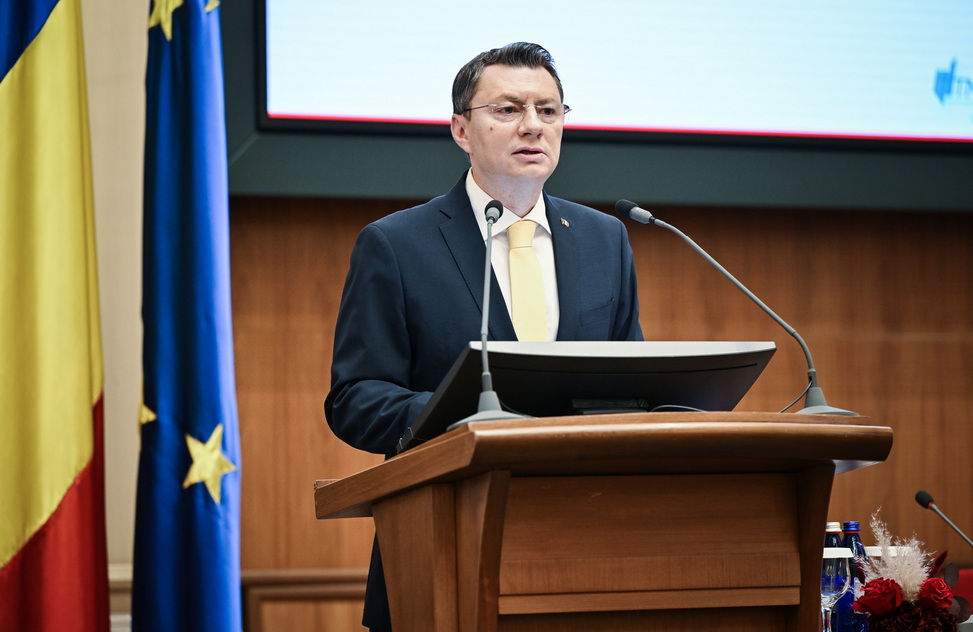
With these ideas, I was delighted to open the European Distressed Investing and Asset Based Lending Summit, hosted by the National Bank of Romania and organized by Turnaround Management Association (TMA) Romania:
“Ladies and gentlemen, distinguished guests,
It is my pleasure, as Deputy Governor, to welcome you to the National Bank of Romania and open this Summit. I would like to congratulate TMA Europe, Secured Finance Network Europe and TMA Romania for bringing this event to Bucharest.
The National Bank of Romania is glad to host this prestigious gathering of international professionals, reflecting our commitment to safeguarding financial stability and the development of resilient credit markets in Romania and across Europe.
Corporate distress is a very important topic for a central bank. We see it in the quality of banks’ assets and the effectiveness of monetary policy transmission. The National Bank’s fundamental mandate is to ensure price stability, which is supported by a sound banking sector and by robust public policies.
Nowadays, uncertainty has become the rule, not the exception. Geopolitical tensions, climate stress and new sources of risks are testing business models across Europe.
Policy challenge is highly demanding. Romania is going through a necessary economic rebalancing, indeed a broader economic turnaround. A growth economic model driven by consumption and public deficits is giving way to a new model in which investment and private capital need to play a larger role.
Let us look now at Romania’s macroeconomic landscape. GDP growth was below 1 percent in 2024 and 2025 and remained weak this year. The disinflation process is underway, with inflation significantly declining during the summer, from more than 10 percent to around 6 percent. The public deficit is reducing, which is consistent with achieving a full-year deficit of around 6 percent of GDP.
Fiscal consolidation and effective use of EU funds are essential for the sustainability of fiscal and external balances. Ultimately, a prudent fiscal stance allows monetary policy to safeguard price stability and provide economic predictability.

Ladies and gentlemen,
Secured finance rests on several institutional and financial pillars: sound corporate governance, financial discipline, adequate capitalization, and timely restructuring. All these are part of the invisible infrastructure that sustains long-term economic growth.
What is particularly relevant for a central bank is that companies with stronger equity can absorb shocks and respond smoothly to changing interest rates. But when too many companies rely on short-term debt or trade credit, monetary policy transmission becomes uneven and asymmetrical across firms and over the cycles.
Therefore, efficient insolvency procedures, transparent collateral frameworks, secured lending and diversified financing are very important. They all contribute to a resilient financial sector and to macroeconomic stability.
At the National Bank of Romania, we evaluate these issues closely not only in our financial stability reports but also in the Economic@NBR project. The latest research, “Financial Sustainability – From Deficits to Nominal Convergence”, addresses issues such as fiscal sustainability, corporate governance and financial discipline.
Under my coordination, the Economic@NBR project is designed to promote economic research, financial education and the dialogue among specialists, academia, policymakers and the wider public.
Ladies and gentlemen,
Economy has two ways of dealing with financial loss. It can admit it, or it can circulate it. Admission is expensive and visible on a balance sheet. Circulation is less visible and can become quite persistent.
This is precisely why early restructuring matters. It preserves viable businesses and releases valuable resources. The purpose is not to prevent failure at any cost. It is to prevent economic value from being destroyed by delay.
Another lesson from recent years is that resilience must begin before crisis emerge. At the National Bank of Romania, we have consistently argued and acted on the principle that resilience is built through prudent policies during good times, not only through intervention during difficult times.
Fiscal strength, efficient monetary policy, well-capitalized banks and responsible risk management provide economic confidence. All these act as a secure anchor to markets and citizens alike.
Personally, I have always emphasized that sustainable prosperity is naturally linked to institutions. Economic competitiveness is a function of trust: trust in rules, namely in institutions and, perhaps even more importantly, in the capacity of societies to undertake reforms.
Ladies and gentlemen,
Romania’s experience proves that European integration and structural reforms are mutually reinforcing. Each meaningful reform brought us closer to European standards, while European cooperation significantly strengthened our institutions.
I hope that today’s discussions will generate practical ideas, new partnerships and innovative solutions to support businesses across our countries. Bringing together economists, bankers, investors, restructuring professionals, lawyers and policymakers under the same roof reflects exactly the multidisciplinary approach required by today’s complex financial environment.
I would like to congratulate once again our partners from Turnaround Management Association Romania on the 15th anniversary and for making this event possible, right here, with us, in the traditional conference room of the National Bank of Romania. You are welcome anytime! Also, congratulations to Concordia Association – partner of this event.
I wish you a productive, inspiring and highly successful Summit today, and an enjoyable stay in Bucharest for our guests.”



Leave a Reply