




OECD/INFE Symposium: Financial Education and Financial Sustainability
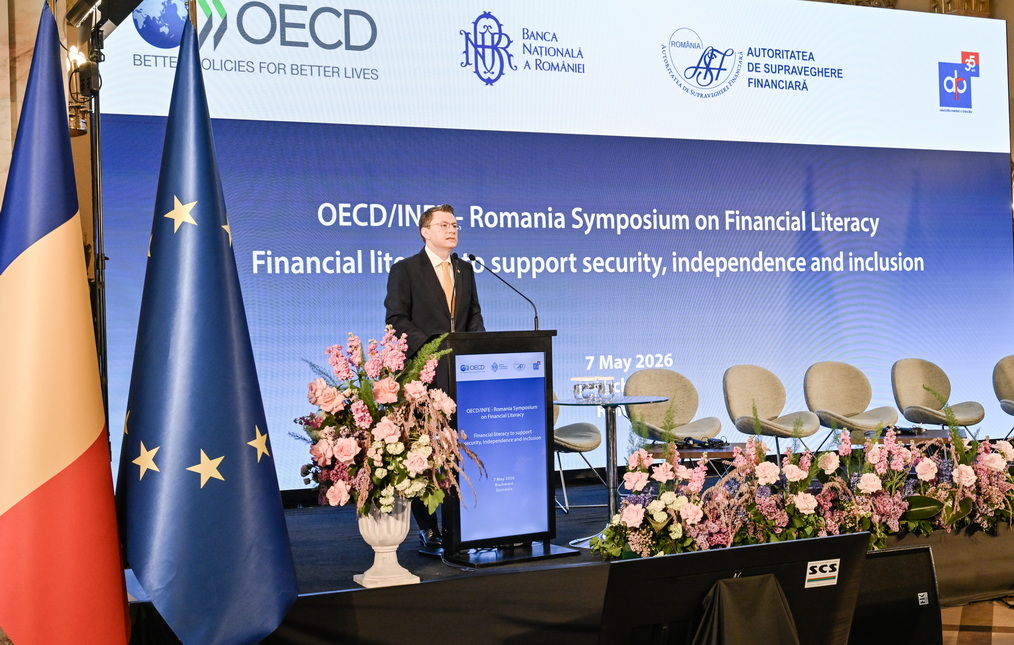 I had the honor of opening the OECD / INFE – Romania Symposium on Financial Literacy, an event organized by the National Bank of Romania in partnership with the Financial Supervisory Authority and the Romanian Association of Banks. The symposium took place at the National Museum of Art of Romania, in the Throne Hall, a venue where the country’s architectural and cultural heritage carries profound historical resonance.
We were delighted to host distinguished guests representing public authorities, central banks, academia, and financial authorities from 65 OECD member and affiliated countries.
The OECD/INFE – Romania Symposium, held under the theme “Financial literacy to support security, independence and inclusion”, was the central event of the biannual meeting of the OECD International Network on Financial Education (INFE), held in Bucharest from 5 to 8 May.
The participation of senior representatives of the Romanian state confirmed the strategic importance Romania attaches both to financial education and to its valuable partnership with the OECD.
The symposium benefited, during its opening session, from messages delivered by the President of Romania, Nicușor Dan, the President of the Senate, Mircea Abrudean, the Vice-President of the Chamber of Deputies, Natalia Intotero, the Prime Minister of Romania, represented by the Head of the Chancellery, Mihai Jurca, and the Minister of Finance, Alexandru Nazare.
In addition, Luminița Odobescu, State Counsellor to the Prime Minister, Alexandru Petrescu, President of the Financial Supervisory Authority, Sorin Ion, State Secretary at the Ministry of Education and Research, Luca Niculescu, State Secretary and National Coordinator for Romania’s OECD accession process, Bogdan Neacșu, President of the Romanian Association of Banks, and Gabriel Avramescu, First Vice-President of the Financial Supervisory Authority, delivered messages in support of financial education on behalf of the authorities and organizing partners.
On behalf of the OECD/INFE, key messages were delivered by Yasushi Masaki, Deputy Secretary-General, Magda Bianco, Chair of the INFE, and Miles Larbey, OECD Head of Financial Consumer Protection, Education and Inclusion. They offered valuable perspectives on the benefits of financial education, while also acknowledging the significant progress made by Romania, including in preparing for OECD accession, expected as early as this year.
In my opening remarks, as coordinator of the National Bank of Romania’s financial education programmes, I highlighted several key ideas regarding the essential role of financial education in ensuring economic stability and sustainability:
• “Financial education has a direct impact on the quality of public policies. When governments prove responsibility, through sound public finances, they send a coherent message in favor of financial sustainability.
• Otherwise, we are faced with the trap of economic populism, and public policies resort only to short-term measures, based mainly on budget deficits and public debt. The global government debt has reached a historical record, 100% of global GDP, raising concerns about long-term fiscal sustainability.
• In such an environment, the principle of economic responsibility must be the one to guide public policies in achieving the much-needed financial sustainability. That is why financial education is essential in promoting sound economic policies.
• As Romania’s integration in the EU has generated significant progress, we are convinced that the OECD accession can generate the momentum for the next stage of our country’s development. The OECD lessons and expertise are especially relevant, and financial education will be a key driver.”

Next, the message sent at the opening of the OECD/INFE – Romania Symposium:
“Mr. President of the Senate,
Madame Vice-President of the Chamber of Deputies,
Mr. Governor, Honourable Ministers,
Distinguished guests, Members of the OECD International Network on Financial Education, Madame Chair of Committee,
Dear colleagues, Ladies and gentlemen,
It is a privilege to address a warm welcome to this distinguished gathering under the auspices of the OECD International Network on Financial Education here in Romania, at the Royal Palace in Bucharest.
I have the great honor to salute the presence of our special guests today – the President of Romania through his message along with the highest representatives of the Romanian state authorities. Their esteemed participation stands as a powerful statement to the strategic importance Romania attaches both to financial education and valued partnership with the OECD.
This special event takes place just before May 9th, the Day of Europe, when we celebrate Romania’s European integration, the most important country project for Romania in our recent democratic history. And we are hoping to also celebrate the OECD accession this year, consolidating our path to economic development.
Being here today, at the Royal Palace – a few days before the Day of Royalty, is also very special. Many thanks for the Ministry of Culture and the National Museum of Art of Romania, for their ongoing support
We meet at a moment of global uncertainty, in the context of the war in the Middle East. The geopolitical tensions and persistent security risks generate volatility across global economy. And this is happening after we have already been under severe distress caused by overlapping crises in the last years.
These times reinforce an essential truth: the economic resilience is built by sound institutions, coherent policies and, very important, informed citizens. In this way, financial literacy is more than an educational issue, it becomes a pillar of economic stability.
Esteemed guests,
Financial education has emerged as a key policy pillar. It enhances the effectiveness of policies and strengthens trust in institutions.
Romania has embraced this vision through our National Strategy for Financial Education, aligned with the OECD principles.
We, the National Bank of Romania – and I am certain I speak also on behalf of our colleagues from the Financial Supervisory Authority and the Romanian Banking Association – will remain fully committed to advancing this agenda, both domestically and internationally.
Financial education has a direct impact on the quality of public policies. When governments prove responsibility, through sound public finances, they send a coherent message in favor of financial sustainability.
Otherwise, we are faced with the trap of economic populism, and public policies resort only to short-term measures, based mainly on budget deficits and public debt. For example, global government debt has reached a historical record, 100% of global GDP, raising concerns about long-term fiscal sustainability.
In such an environment, the principle of economic responsibility must be the one to guide public policies in achieving the much-needed financial sustainability. That is why financial education is essential in promoting sound economic policies.
Ladies and gentlemen,
Romania’s accession to the OECD is a defining strategic objective. It reflects not only ambition, but also years of reforms and institutional changes.
I remember the 2016 OECD Public Governance Scan of Romania, 10 years ago. Back then, we were laying the grounds for what has now become the final stage of accession. What we are witnessing now is not a sudden achievement, but a long-term national effort, based on European values and international best practices.
Romania’s progress must be understood within its broader strategic anchors. Our European Union and NATO membership has fundamentally shaped our economic and institutional development.
As Romania’s integration in the EU has generated significant progress, we are convinced that the OECD accession can generate the momentum for the next stage of our country’s development.
It will further strengthen governance, improve policy design, and enhance our capacity to navigate an increasingly complex environment. The OECD lessons and expertise are especially relevant, and financial education will be a key driver.
Looking ahead, we must remain guided by the lessons of the past and the realities of the present. Financial education, institutional strength, and international cooperation are not separate priorities, but interconnected pillars of sustainable development.
If we succeed in accomplishing all of them, we will not only build stronger economies, but also resilient and informed societies. And ultimately, this is the most valuable investment we can make for our future.
Thank you, and I wish you all an inspiring conference!”


Leave a Reply